What’s the best way to get around Africa?
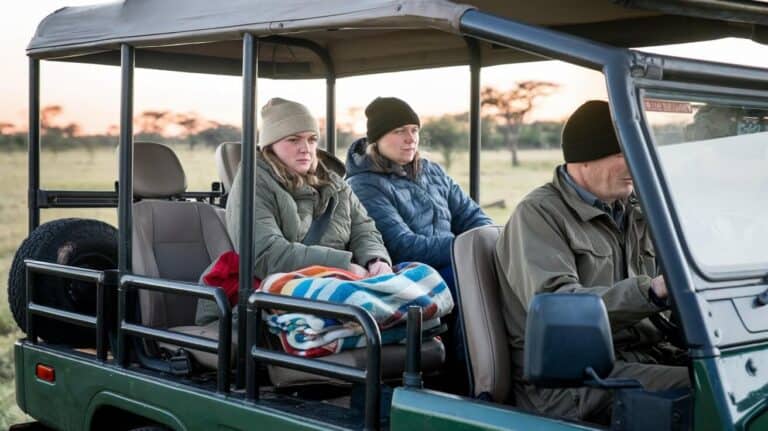
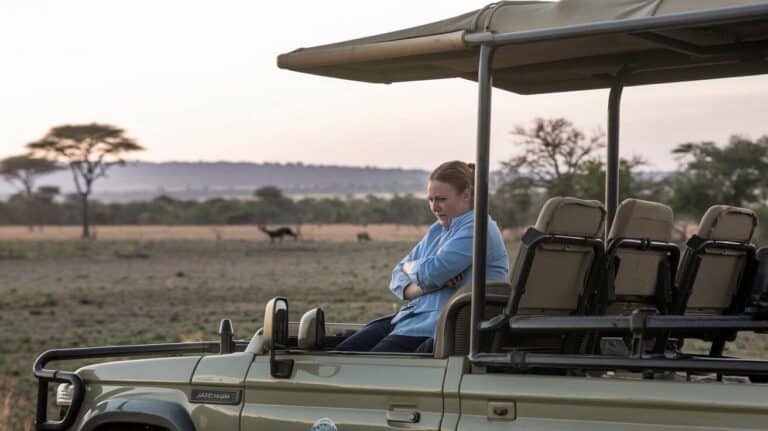
The best way to get around Africa depends on the region, but most travelers use a combination of domestic flights, private transfers, and guided safari vehicles. Flights are ideal for long distances, while lodges typically arrange transport within safari areas for safety and convenience.
- Flights for long distances
- Private transfers for safaris
- Car rental in the cities of developed countries
- Ride apps in cities
- Trains for luxury overnight travel or those specific to sightseeing
If you’re trying to figure out how on earth you’re going to maneuver your way around all of the travel logistics on your safari in Africa, I’ve got you covered!
A lot of it is quite straightforward, especially of you book yourself onto a group trip as everything is planned out for you.
But if you’re creating your own itinerary and planning everything yourself, it might start to feel a bit overwhelming.
Ready to plan? Let’s get started!
Getting Around in a City in Africa
Getting around in a city is easy. I’m not talking about the remote little villages, but the busy urban cities that have the international airports.
From the airports to the hotels, from the hotels to restaurants, all major cities in African safari countries are easy to get around.
Let me first give you a quite rundown of the major cities and their 3-letter airport codes, just in case you are still looking to book your flights:
South Africa — Cape Town (CPT), Johannesburg (JNB) and Durban (DUR)
Namibia — Windhoek (WDH)
Botswana — Maun (MUB) or Kasane (BBK)
Zimbabwe — Victoria Falls (VFA) and Harare (HRE)
Zambia — Livingstone (LVI) and Lusaka (LUN)
Tanzania — Kilimanjaro (JRO) and Arusha (ARU)
Kenya — Nairobi (NBO)
Rwanda — Kigali (KGL)
If you’re staying at a hotel, I suggest you would with them if they offer airport – hotel transfers. Some do. Some are free and others aren’t. Check this out before you travel.
Alternatively, if you are a bit nervous, don’t want to hire a car, and aren’t keen on testing your driving skills on ‘the other side of the road,’ then simply book a transfer.
Getting around with Uber & Bolt
Download the app and go! Do your due diligence and check that licence plate number on the app matches the licence plate number on the car.
But otherwise, they are pretty safe and thousands or people use Uber especially, on a daily basis.
City tours
When it comes to day tours, most of the tour companies will collect you from your hotel and then drop you off again at the end of the day.
Just make sure to give them the address of where you are staying, tell them if there are special instructions (come down the side road in XYZ Street and ring the bell), and lastly ask them for a pick-up time and a contact number incase there is a delay or you need to make a last-minute change or cancellation.
Trains
Travel travel in major cities is not very popular for travellers.
In Cape Town, locals use trains for peak hours to get to work, and to get home again but they are packed. You will not find a seat.
Genrally speaking, trains are not the safest form of transport, unless you’re in a large group but in saying that there are a couple of excpetions.
In Cape Town there is a breakfast train that runs
There is also The Silent Book Club which does on occasion, get together for a train trip.
But in general, train travel is sadly no longer very safe, with a few exceptions:
- Ceres Rail – starts in Cape Town and is more for day excursions
- The Gautrain in Johannesburg
- Rovos Rail – luxury overnight train
- The Blue Trains – luxury overnight train
Hire a car
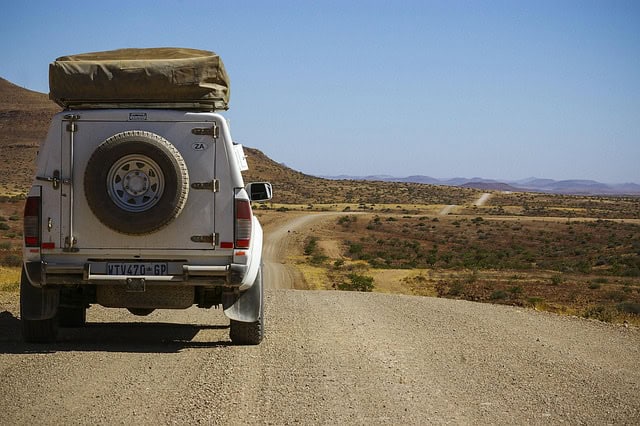
In South Africa and Namibia, car rental is a good idea if you’re the type of traveller who likes to explore and wants the flexibility.
Hiring a car is perfect for a road trip, especially if you want to explore places like the Garden Route in South Africa.
There are also limits to this as you cannot do your own game drives in private game reserves, but you can in certain places such as the Kruger National Park. I strongly suggest checking this in advance if you want to hire your own car.
Road Transfers vs. Flying: When Each Makes Sense
When planning your African adventure, depending on where you go, one key decision is whether to travel by road or by air between destinations.
Flying is often faster and more comfortable, especially when distances are long or roads are rough — a flight from Cape Town to Port Elizabeth is 1 hour 20 minutes, but to drive it will take you around 10 hours.
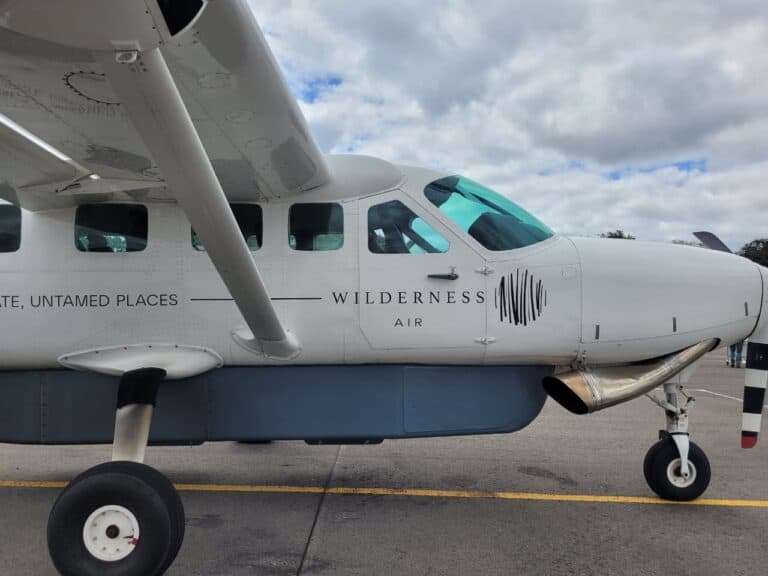
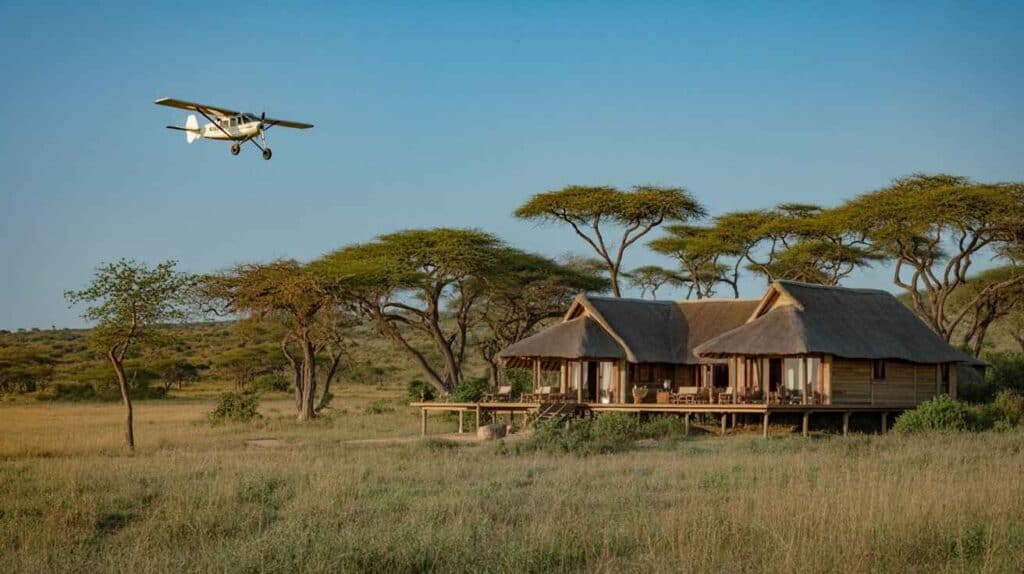
In the bush (when on safari in places like Kenya and Tanzania, a bush flight can save you 6 to 10 hours of bumpy driving. However, flights can be expensive, and small aircraft have strict luggage regulations you need to follow, or that bag isn’t going with you.
Road transfers are usually more affordable and offer a chance to see local landscapes and villages along the way, but they can be tiring, especially on unpaved or poorly maintained routes.
Safety is another consideration: while air travel in Africa is generally safe when booked through reputable operators, road travel requires an experienced local driver familiar with regional conditions.
Ultimately, your choice will depend on your budget, schedule, and tolerance for long drives or small planes.

Flying Between Lodges and Camps on a Safari
The first thing I need to tell you is that you don’t need to fly to lodges in SOME countries. In others, it’s the only way to get to the lodges.
Most lodges are remote, the distances are too great, and the road conditions are not good.
In Botswana, if you’re going on a safari in the Okavango Delta, most of them time you don’t have any choice but to fly.
In Namibia, the distances between lodges are huge. Some people do rent a 4 x 4 vehicle and drive, but they have the time, and they do this over a few weeks. It is must faster and efficient to fly if you have limited time.
In South Africa, you can fly to most safari game lodges, or you can drive yourself, or often you can book a road transfer.
In Zimbabwe, you can book a road transfer, drive or fly to Hwange National Park, but you need to fly to Mana Pools National Park.
In Zambia, you need to fly.
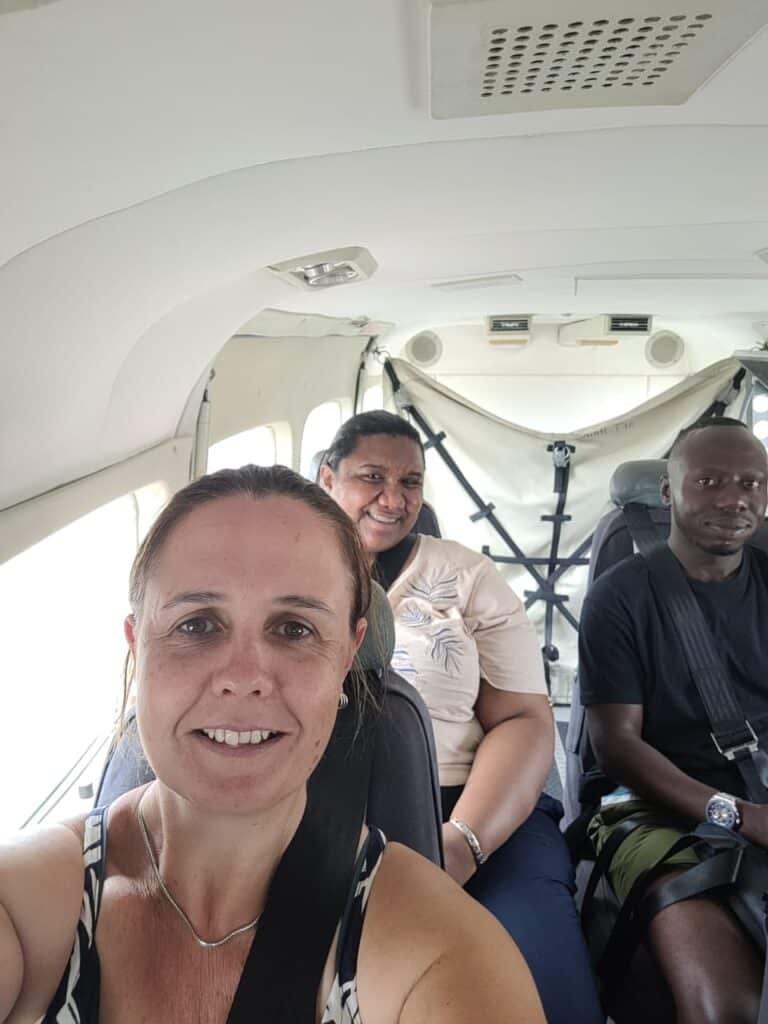
In Tanzania and Kenya, some people who have time, do drive themselves. There are safari package tours that you can book that will drive you by road. But most people fly.
In Rwanda, transfers between lodges are by road, or helicopter. There are a few commercial flights within the country, but these are limited.
Flying in Botswana, Zimbabwe and Zambia
When you arrive at the international airport of the country, you will be met by the smiling face of a representative from the airline that you will be using, to fly you from the airport to the airstrip of your lodge.
For example: if you land in Maun, Botswana and are booked with Mack Air to fly you to a lodge, a representative from Mack Air will meet you. If you’re booked with Wilderness Air, a representative from Wilderness Air will meet you. And so on. Just look for a board with your name on it once you enter the arrivals hall, after customs and immigration.
Now, on the circuits and routes within these countries, you will most likely only have a departure time for your first flight that leaves the international airport. These flights are also (behind-the-scenes) arranged around the incoming commercial flights.
There’s seriously a lot that happens in the background regarding logistics, that most travellers are completely unaware of.
If you are staying at a few camps or lodges, you will have multiple flights booked. The rest of your flight times in that country will be advised to you when you are in the camp. The airlines update the camps on the flight times for the following day, as the camps need to get you to the airstrips on time. Then at around dinner time, the camp manager will update you.
If you are not happy with the flight times, there is unfortunately nothing you can do to change it if you are booked on a scheduled flight as these planes are scheduled on a circuit to pick up and drop off people at lodges throughout the day.
If you do want to be able to specify your departure times, then you absolutely have to book private charter flights. These are more expensive and this must be done in advance.
The airlines do try and make it around mid-morning, so you have time to get in a final game drive and enjoy brunch before departing.
But sometimes this is unavoidable, and this is where the complaint comes in. People are told they are departing from their camp early in the morning, as this means they will miss their morning game activity. Sometimes it can’t be helped, but this doesn’t happen very often.
On the flip side, they will get to their next camp early and can join in what’s available there.
Why you can’t change flight times…
The reason you can’t change the times is because the bush plane flights operate on a circuit. So, they’re picking up people off a commercial arrival flight, and then the flight departs on its circuit. There will be different airstrips along the way where other people may need to be picked up and dropped off, so any delays or changes will impact every person and every camp that has to do drop offs and collections from the airstrips.
So be prepared for some possible ups and downs when flying! It’s just the way it works, and all flight companies work like that.
The only way to guarantee a direct flight with no stops en route to your camp, is to book a private charter.
The airlines also need to schedule the flights so that the last flight will drop any travellers off at the next major airport in time for their commercial flight out.
Flying Around Kenya and Tanzania
In my opinion and experience, the biggest problem with flying in the small planes around Kenya and Tanzania is that when you book your flight, you are issued a ticket, and it will show your flight departure and arrival times at the various airstrips.
But nobody reads the small print.
There are two issues that always come up:
- Flights are usually not direct from one point to another. There are usually multiple stops in between where you start, and your destination. So, while your ticket might say you are flying from Kilimanjaro to Grumeti, it doesn’t tell you that there are three stops in between, for example. That means you will land and take off multiple times on your flight. You usually only find out the number of stops once you are at the airport or airstrip, ready for your flight.
- Flight times on your ticket will usually change. Even though your ticket will have flight times on it, the airlines only do their final scheduling 24 hours before the flight. And it is extremely common for there to be time changes. Like, this happens almost on a daily basis. The airline will notify the hotel or lodge where you are staying the night before your flight, and the manager will let you know. These times are usually only given to the hotels and lodges in the later afternoon, and sometimes the evening.
How to Avoid These Flight Changes
The only way to secure a direct flight, and to be sure of flight times is to book a private charter light.
That is the only way.
This can be expensive, but if there are two are three couples travelling in your group, this is often a better option and by splitting the cost of the private charter between everyone, the cost per person isn’t much more than the cost of a normal scheduled bush flight.
Let Hotels and Lodges Know Your Travel Details
If you are booking your safari and making all of the reservations yourself, let the lodge know how you are getting there, and how you are departing at the end of your stay.
This is because the lodge team will contact the airline to reconfirm your flight arrival time (and departure time) so that your guide will be at the airstrip ready and waiting for you when you land. Or have you there in time for your flight when you leave.
If you are getting to the lodge by road, either self-driving or with a transfer, make sure you give the lodge your mobile number that you will be using while you travel.
Often it gets to 18h00 or 19h00, and lodges and hotels call and asked if I know where the travellers are because they haven’t checked in yet. And if its later, especially in Namibia, they will send people out to go and look for the guests.
Commercial Flight Delays and Cancellations
This is so annoying but let’s face facts, there’s nothing you can do about it. When this happens, you are usually notified by the airline via email or on your phone.
If this happens to you on your safari, while you’re staying at a lodge, you need to let the camp manager know. They will contact the ‘bush plane’ company and let them know, and they will try adjust the flights to get you to the airport on time for your commercial flight home.
You might, however, end up with a few extra hours in the airport or major city, but rather be there and be ready than miss your flight and you have to book a new international flight home.
(If you do have to do this, make sure you are covered by your travel insurance and keep all invoices and receipts).
It’s different though, if your international flight into Africa is delayed (or cancelled). For example from Le Guardia to Nairobi. If that flight is delayed arriving into Nairobi and you’re supposed to head out on a flight that same day to your safari lodge, the ‘bush plane’ airlines will not wait for you. Well, they do try for a little bit if the delay is minimal, (like 20 minutes), but they can’t wait too long otherwise their whole circuit is delayed.
Let’s say your international flight was meant to arrive at 09h00 in the morning into Nairobi, and your bush plane flight is scheduled to depart at 12h00.
If your international flight lands at 11h30, there is no way you are going to clear customs and immigration, take a taxi or transfer to Wilson Airport (the domestic airport in Nairobi) and make that 12h00 flight.
You can go to that airline counter and ask if they have seats available for the afternoon flight, if there is one. If not, you will have to try and book your bush plane flight for the following day.
You will then need to book an overnight in the city – and you have to pay for this upfront and claim back from your travel insurance.
It might sound a bit complicated but take it step by step or contact me and I will try and help answer your questions. Happy safari travels!
Frequently Asked Questions
Book road transfers, car hire or use Uber & Bolt.
In the major cities, use transfers or taxis. To get to safari lodges, flying in bush planes is faster. You can book transfers but these can be very long and the road conditions aren’t always great.
Bush planes are usually the only way as most camps are far, or within the Okavango Delta which has a lot of water, and floods seasonally.
Usually not. They will collect you from the airstrip and take you back again, but it’s your job to get to the airstrip.
You can drive yourself to a lodge but once there, you are not allowed to do your own game drives, unless you are in a national park. If you stay at a lodge on a private concession, you will park and leave your car and enjoy game drives with the lodge’s vehicles and guides.